Center of expertise on nonlinear thermodynamic complex-systemic macro-analysis of human and natural domains



EntropoMetrics
Our socio-economic domains are fundamentally driven by non-linear thermodynamic undercurrents, just like natural systems such as the climate-system and ecosystems. Specifically, at a high abstraction-level, all these dynamics abide to the same so-called 'Maximum Entropy Production Principle'. This is a very technical and abstract principle, and it is currently not well understood.
But in the current era of the IT-revolution and globalization, where governmental policies are increasingly failing to address the biggest issues of our era, we think this principle holds the key to effective policies.
To be able to perform research and provide consultancy on the application of this principle to our socio-economic, financial and technological domains, by means of qualitative and quantitative analyses and visualizations, EntropoMetrics has developed a conceptual and metric framework, based on complex/non-linear dynamics, chaos-theory, thermodynamics/statistical mechanics and other sciences.
A lot of work has gone into maximizing the level of abstraction and strict formalization of the terminology of this conceptual framework, to prevent any 'anthropocentric' or ambiguous 'normative' aspects creeping into our methodology. This yields a broadly applicable paradigm for effective and empirically supported policy-making.
Latest articles and publications
The core thesis of EntropoMetrics concerns the inference that, for dissipative systems, it holds that entropy does not only increase, but
it increases as fast as possible. This has profound implications for the understanding of non-linear systems from a natural science perspective (such as living systems), and for our
understanding and dealing with our socio/financial/economic/technological ('growing') systems from a policy perspective.
This is slightly mathematical paper, and can be found as a preprint here
The most important corollary of this thesis applies to so-called 'Self-organizing Criticalities' like living systems, and todays globalized techno/financial/economic system.
Self-organizing criticalities seem to defy the 2nd law of thermodynamics, and within the current paradigm this cannot be explained. We therefore introduce the notion of 'StateSpace-curvature' (in full analogy with
Einsteins SpaceTime-curvature), which yields a paradigm in which the emergence and existence of SoC's actually IS consistent with 2nd law of thermodynamics, and explainable as such. This is a fundamental, synthesizing paper and can be found
as a preprint here.
The main application of this thesis sits in the domain of
so-called 'complexity economics'. The main non-technical publication on this 'It's the Entropy, Stupid!', which can be found here.
More publications can be found on this page.
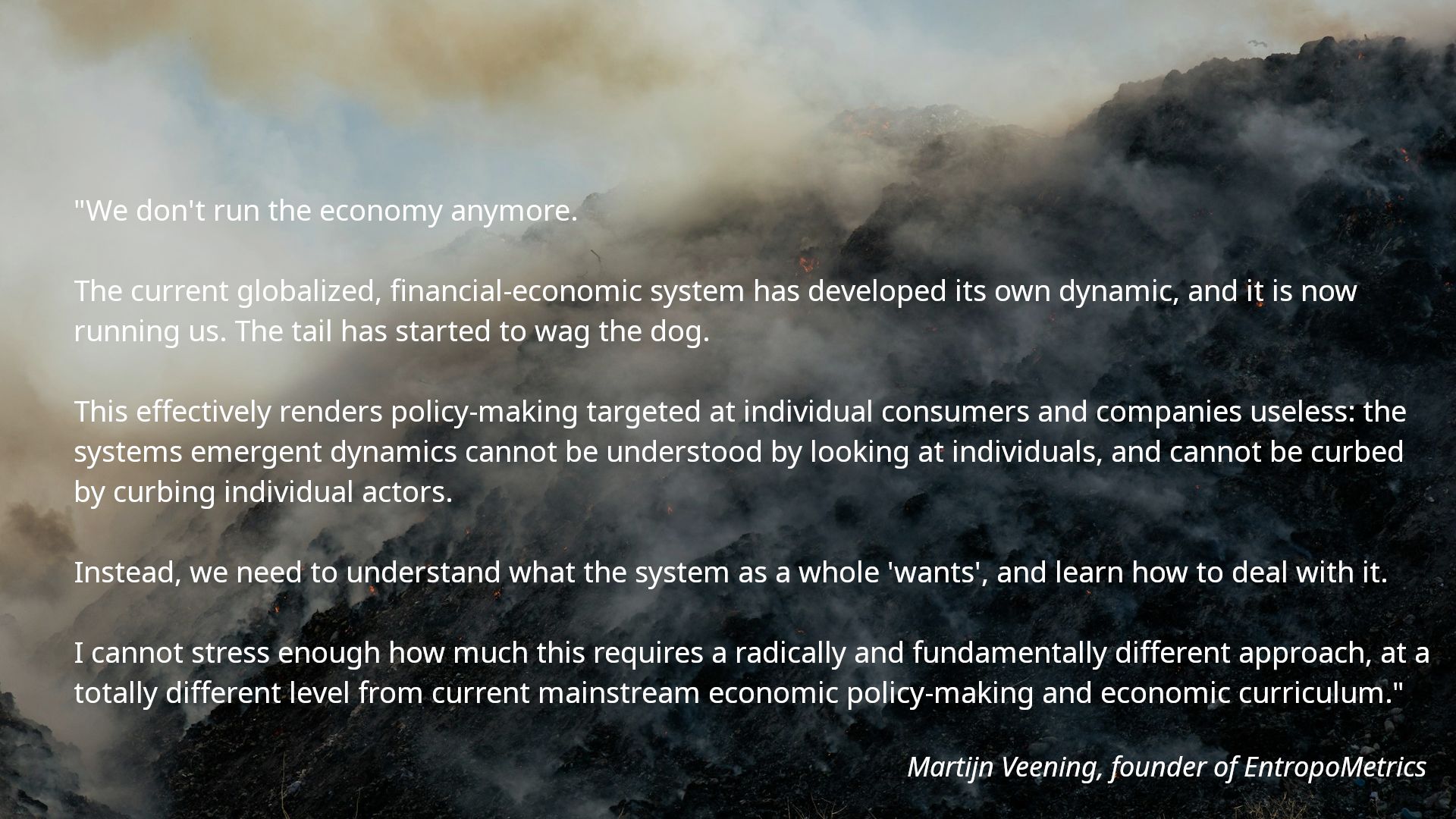
The 'polycrisis' / our global predicament
Industrialization and our current globalized economy has brought a lot of wealth and increase in living standard for many. Flat economies have direct positive and negative feedbackloops, which prevents excessive imbalances, just like in natural ecosystems. The globalized economy, however, is not at all flat anymore and allows for excessive imbalances resuling in malign systemic effect on the long run.
Overpollution, resource exhaustion, increasing social and geographic wealth inequality, decreasing overall human physical and mental health-levels, desertification, deforestation, wide and severe ecosystem-degradation, likely effects on climatological and thermohaline macrodynamics etc etc are negative consequences of an economic system in overdrive. The ubiquitous availability of cheap energy has resulted in an economic systems that relies on overproduction/overconsumption. Negative feedbackloops are now 'systemic' (like the systemic financial crisis of 2007/08 and spanning many more 'systems') and are pushing things to a crisis-level. Because it concerns so many social-economic and natural domains, many people call it a poly-crisis. Because this obviously classifies as a 'wicked problem' (so complicated that it does not have a single/simple solution) others prefer the term '(human) global predicament'.
Reports like 'Limits to Growth' (1972) by the Club of Rome and the UN 'Brundtland Report' (1987) have gained a lot of traction in both academia and civil initiatives. They rightfully argue that a globalized economy that relies on economic growth cannot be sustainable indefinitely. A global systemic kind of 'collapse' is increasingly recognized, and has led to several new disciplines and frameworks to address this. The degrowth-movement is perhaps best known, and heterodox economic disciplines like 'complexity economics' and 'econophysics' are gaining traction, albeit remain academic. Also practical initiatives like bioregionalism are spawning (as an undoing of globalized food/resource production chains). Both huge political and civilian efforts are required to turn things around, but the inertia of the current system is notoriously hard to defy.
Position of EntropoMetrics
The EntropoMetrics approach even states that we do not even have a proper fundamental understanding of the 'drivers' of the global system, and tries to provide a more
complex-systems based, energy-aware 'diagnosis' of the thermodynamic undercurrents present, recognizing the global system as a metabolic superorganism.
It presumes specifically that this physical momentum outperforms any political or grassroots momentum, so
this has to be addressed first and foremost. We want to frame the polycrisis not as economic or political or moral crisis, but as an autonomous, emergent physical systems aspect.
As such it seeks to provide a thermodynamics and complexity-sciences based diagnosis and approach to the polycrisis, where interventions are done in
the deepest transactional market-infrastructure rather than through regulatory behavior-targeting policies.
Roughly speaking, it seeks to provide a natural-sciences approach, as it regards this as an inevitable but currently missing complement to the established social-sciences approach to the polycrisis.


About Martijn
Martijn is the founder of EntropoMetrics.
Martijn classifies as a 'generalist' with a strong analytical mind. He has a background in math, logic, computer sciences and physical sciences.
In his personal life he followed a 4-year theater-education and a multi-year programme in 'personal leadership' which addresses intuitive development.
He loves music, cycling, books, forests and photography, and of course his 2 sons.
His mathematical interests in chaos theory, complex-dynamic systems and catastrophy-theory date from early youth, and extends to living/ecosystems, evolution, climate/thermohaline dynamics, physical systems and financial/economic systems. He frequently writes on systems and visits economics- and polycrisis-related conferences.
Intellectually he is heavily influenced by his father Eite, a (now retired) doctor in philosophy with a professional history in mental health academia and education, both on (applied) ethics and fundamentals in psychotherapy and other client-centric disciplines. Eite's doctoral treatise, a consolidation of Karl Poppers 3-World Theory, serves as a framework for proper thinking about humans and their relationships to their habitats. They share a passionate preference for 'consistency in thinking' over 'finding answers' and discuss frequently.
Professionally he has worked in IT. As a self-employed IT-specialist he developed a full-fledged Departure Control System which has served as the single DCS at Groningen Airport for over 10 years. He now works at an academic hospital as an IT project-specialist.
His IT-career trained him in effortlessly navigating between abstraction-layers and bridging the gap between technical and real-world domains. He brings strong communication skills and a constructive attitude, and always finds balance between substance and narrative.
LinkedIn post: "The emergence of self-eating markets"
"... Let that sink in: market-makers now outperform market-players. Capitalism is not the primary game anymore, the gaming of capitalism is the new game. It is a meta-game! ..."
Read further on LinkedIn
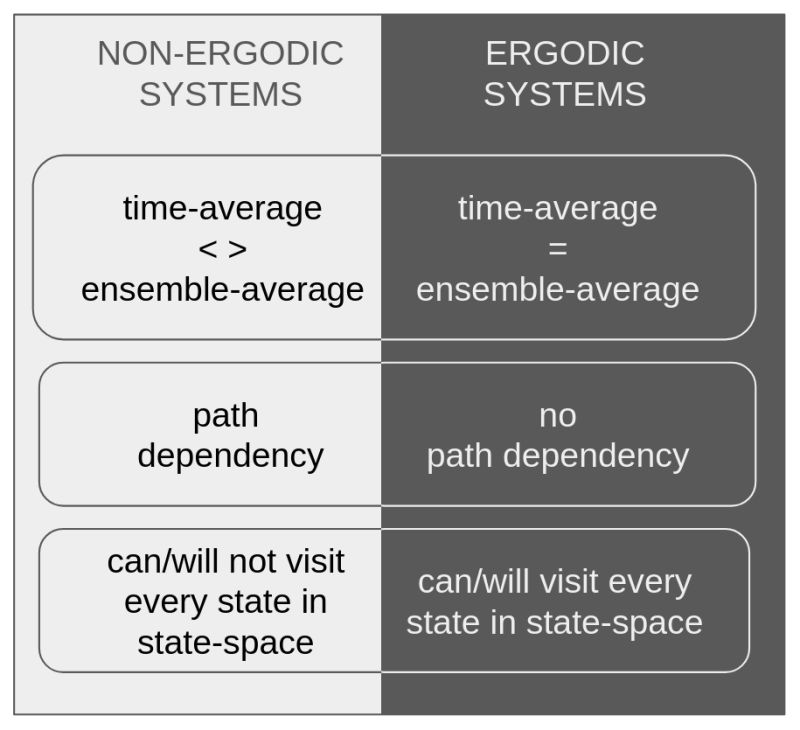
Ergodic or non-ergodic
That is the question!
Dynamical systems can be classified as either ergodic or non-ergodic.
This rather abstract statistical property tells you something about the
macro-behavior of the system.
At small scale this difference does not often matter
but if you want to create a model for macro-scale behavior of a system,
diagnosing this property correctly can be a critical aspect for model correctness.
Luckily there are many faces to (non-)ergodicity, and if you can empirically establish one of these faces, the others hold as well.
EntropoMetrics services
[coming soon]
Some notions and frameworks
[coming soon]
Youtube-content
[coming soon]
Recommended reading
[coming soon]
What I'm reading
[coming soon]
